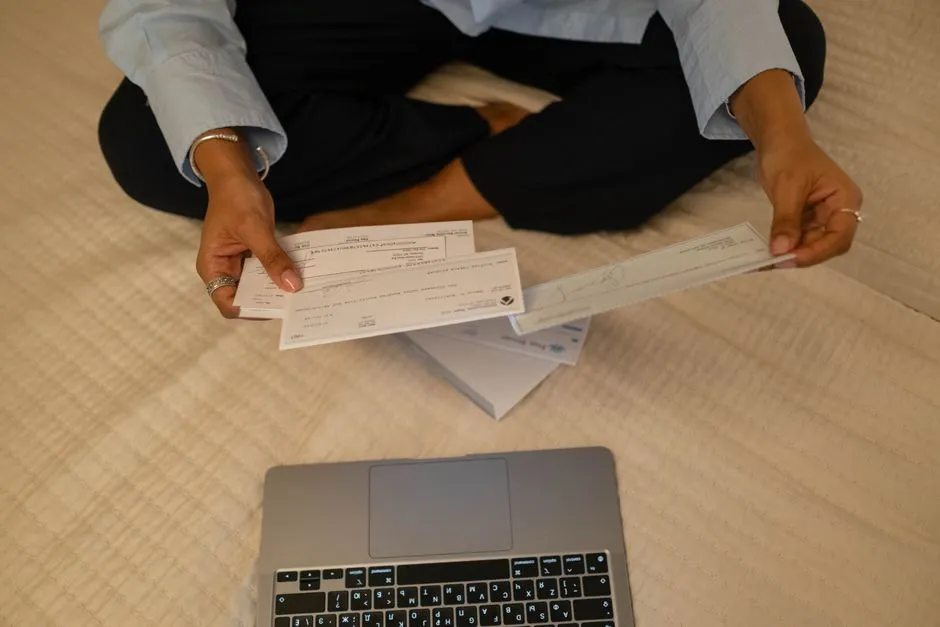
Every US check is laid out the same way, no matter which bank issued it. That uniformity is not an accident: the Federal Reserve, in cooperation with the American National Standards Institute (ANSI), publishes the X9.100 series of standards that fix the position, dimensions, and ink properties of every field on a paper check. The reason is throughput. The Federal Reserve and large clearing banks process millions of checks a day; if every bank used a different layout, automated reader-sorter machines couldn't keep up.
The front of a check
Top-left: bank-printed personalization
The top-left corner contains the account holder's pre-printed name and address (and, for some business accounts, a logo or business identifier). Some businesses leave this corner blank when ordering checks so they can stamp it themselves — but doing so also removes a useful fraud-deterrent: a teller noticing that the printed name doesn't match the signature is a real check on forgery.
Top-right: check serial number and date
The pre-printed check number in the top-right corner matches the last four digits of the MICR line at the bottom. Treat the number as a sequence-control device: never skip numbers, never reuse them, and reconcile any missing numbers with your bank during your monthly reconciliation. The date line sits just below the check number.
Center: payee, amount box, written amount line
The center of the check carries the three pieces of information that, together, instruct the bank to pay. The payee line names who may negotiate the check, the numeric amount box and the written amount line both encode how much. As discussed elsewhere on this site, the written amount controls if the two amounts conflict.
Bottom-left: memo
The memo (or "for") line is informal — banks don't act on it — but it is a permanent part of the cleared-check image, so it doubles as a free annotation surface for accounting purposes.
Bottom-right: signature
The signature line is the only place where the account holder authorizes payment. A check without a signature is invalid; a check with a signature that doesn't match the signature card on file may be returned as a forgery.
Bottom strip: the MICR line
The MICR (Magnetic Ink Character Recognition) line at the bottom encodes the routing number, account number, and check serial number in a special font (E-13B) printed in magnetic toner. This is what the Federal Reserve's high-speed check sorters read to decide which paying bank to send the check to. We have a dedicated MICR line guide with more detail.
The back of a check
Endorsement area
The top 1.5 inches of the back is reserved for endorsements. Federal Regulation CC requires this area to be set aside so the depositary bank, paying bank, and any intermediary banks can stamp their endorsements without overwriting one another. The recipient endorses the check on the very top edge — for businesses, this is usually a stamp reading "For deposit only — <business name> — <account #>".
Restrictive endorsement
"For deposit only" is a restrictive endorsement: it limits what can be done with the check (deposit only, no cashing). Always endorse business checks restrictively — if a stack of checks-to-be-deposited is lost or stolen, restrictive endorsements prevent anyone else from cashing them.
Watermarks and security features
Look for an "Authentication Document" or "Original Document" watermark on the back, visible only at certain angles or under UV light. Modern check stock often includes microprinting along the signature line and chemical-reactive paper that turns brown when an attempted alteration uses a solvent. These are forgery deterrents, not preventatives — they are most useful as evidence after the fact.
Why the layout matters for printing your own checks
If you print checks yourself rather than ordering them from your bank, you need to land the MICR line in a precise vertical band: 5/8 inch from the bottom edge, with at least 3/4 inch of clear space below the printed characters. Land the MICR line outside that zone and the Federal Reserve's sorters will reject the check, forcing manual processing — and your bank may pass the per-item handling fee on to you.